
Varunraj kalse
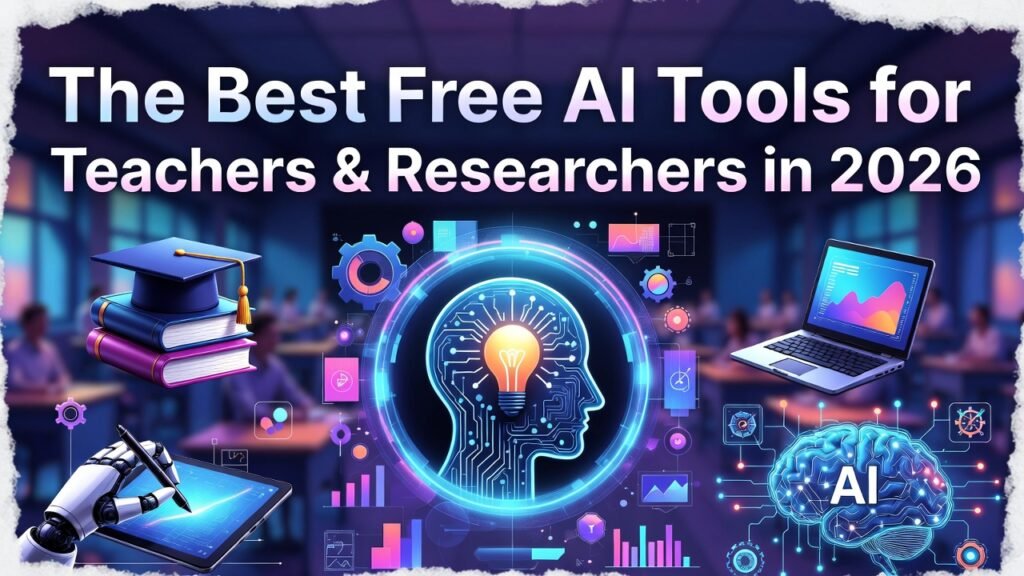
The Best Free AI Tools for Teachers & Researchers in 2026
- ,
- , Contributers
The Best Free AI Tools for Teachers & Researchers in 2026
In the fast-evolving landscape of education and academia, artificial intelligence has become an indispensable ally. As we navigate 2026, AI tools are not just novelties—they’re essential for handling the demands of teaching, research, and knowledge dissemination. For teachers, these tools can automate administrative tasks, personalize learning experiences, and spark student engagement. Researchers, on the other hand, benefit from AI’s ability to sift through vast datasets, summarize complex papers, and uncover hidden connections in literature. The best part? Many of the most powerful options are completely free, democratizing access to cutting-edge technology.
The Best Free AI Tools for Teachers & Researchers in 2026
This blog post dives into the best free AI tools tailored for teachers and researchers. Drawing from recent advancements and user-tested recommendations, we’ll explore tools that save time, enhance creativity, and maintain ethical standards. Whether you’re crafting interactive lessons or conducting groundbreaking studies, these AI solutions can transform your workflow. Let’s break it down by category, highlighting key features, use cases, and tips for getting started.
Top Free AI Tools for Teachers
The Best Free AI Tools for Teachers & Researchers in 2026
Teachers often juggle lesson planning, grading, student engagement, and administrative duties. Free AI tools in 2026 focus on easing these burdens while promoting inclusive, dynamic classrooms. Here are some standout options:
MagicSchool.ai:
This platform tops many lists as a comprehensive AI suite built specifically for educators. It offers over 60 tools for generating lesson plans, quizzes, rubrics, and even individualized education programs (IEPs). For instance, you can input a topic like “climate change” and get a full unit outline with differentiated activities. The free version supports unlimited use for core features, making it ideal for busy K-12 teachers. Teachers praise its ease of integration with Google Classroom and its focus on ethical AI use, such as detecting student plagiarism without invasive monitoring.
Google Gemini:
As Google’s flagship AI, Gemini integrates seamlessly into Workspace apps like Docs, Slides, and Classroom. It’s excellent for brainstorming ideas, creating custom “Gems” (pre-set prompts for tasks like essay feedback), and generating multimedia content. For example, teachers can use it to design interactive slides or translate materials for multilingual classrooms. The free tier provides robust access, with advanced features available via education accounts. Its research-aware capabilities pull from reliable sources, ensuring content accuracy.
NotebookLM:
Another Google gem, this tool turns uploaded documents into interactive study aids. Teachers can feed it textbooks or articles to create summaries, quizzes, or even audio podcasts for flipped classrooms. It’s particularly useful for differentiating instruction—generate simplified explanations for struggling students or deeper dives for advanced ones. Completely free, it supports up to 50 sources per notebook, making it a staple for content curation.
Canva for Education:
While not purely AI-driven, Canva’s Magic Studio features leverage AI for design automation. Teachers can create posters, infographics, and videos by describing ideas in text—e.g., “animated timeline of World War II.” The education version is free for verified teachers and includes templates tailored for classrooms. It’s great for visual aids that engage visual learners and integrates with tools like Google Drive.
Brisk Teaching:
This browser extension embeds AI directly into your workflow, working within Google Docs or YouTube. It can generate lesson plans from videos, provide instant feedback on student work, or suggest engagement strategies. Free for core use, it’s praised for its non-disruptive integration, helping teachers save hours on prep without switching tabs.
Curipod:
Focused on interactive lessons, Curipod uses AI to build slide decks with polls, discussions, and activities based on your prompts. Input a standard like “understand fractions,” and it creates ready-to-use presentations. The free plan allows unlimited creation, perfect for fostering student participation in real-time.
Khanmigo:
Powered by Khan Academy, this AI tutor is free for teachers and helps with planning, grading, and even simulating student-tutor interactions. It can generate practice problems or explain concepts in simple terms, making it a versatile tool for personalized learning.
These tools collectively address common pain points, from time-consuming planning to adapting to diverse student needs. By starting with one or two, teachers can gradually incorporate AI without overwhelming their routines.
The Best Free AI Tools for Teachers & Researchers in 2026
Top Free AI Tools for Researchers
Research demands precision, efficiency, and insight amid information overload. In 2026, free AI tools excel at literature discovery, data synthesis, and writing support, helping researchers stay ahead without breaking budgets.
Perplexity AI:
This AI search engine provides contextual summaries with citations, ideal for quick topic scoping. Ask “recent advances in quantum computing,” and it delivers sourced overviews, reducing hours of manual searching. The free version handles complex queries well, with pro features for heavier use.
Semantic Scholar:
Backed by the Allen Institute, this free platform uses AI for paper recommendations, citation graphs, and trend analysis. It identifies influential works and emerging topics, making it essential for literature reviews. Features like TL;DR summaries save time on dense abstracts.
Consensus:
Searching over 200 million papers, Consensus answers yes/no questions or synthesizes findings from studies. It’s grounded in evidence, minimizing hallucinations—perfect for evidence-based research. The free tier supports unlimited searches, with AI-drafted summaries.
Research Rabbit:
This tool maps literature visually, showing connections between papers like a “mind map” of research. Start with a seed paper, and it suggests related works, helping uncover gaps. Completely free, it’s great for interdisciplinary studies and collaborative projects.
Elicit:
Designed for literature discovery, Elicit analyzes papers to extract key data, methods, and findings. It can summarize multiple studies at once or answer specific questions like “effects of AI on productivity.” The free plan allows generous usage for early-stage research.
SciSpace:
This all-in-one platform summarizes papers, explains concepts, and even paraphrases text ethically. Upload PDFs for instant insights, or use its copilot for querying across documents. Free access covers core features, making it a go-to for writing and review.
Litmaps:
For tracking literature, Litmaps creates interactive maps of citations and collaborations. It’s free for basic use and helps visualize research landscapes, ensuring you don’t miss pivotal works.
Overlaps like NotebookLM and Gemini serve both groups, bridging teaching and research by handling document analysis and content generation.
The Best Free AI Tools for Teachers & Researchers in 2026
Integrating AI Ethically and Effectively
While these tools are powerful, success lies in ethical use. Always verify AI outputs against primary sources, disclose AI assistance in publications, and teach students about responsible AI. For teachers, focus on tools that enhance human interaction rather than replace it. Researchers should prioritize tools with transparent sourcing to maintain academic integrity.
In conclusion, 2026’s free AI tools are revolutionizing education and research by making advanced capabilities accessible to all. From MagicSchool.ai’s classroom magic to Consensus’s evidence synthesis, adopting these can amplify your impact. Start small—pick one tool that addresses your biggest challenge—and watch your productivity soar. As AI evolves, staying informed ensures you harness its full potential for a brighter, more innovative future in learning and discovery.
The Best Free AI Tools for Teachers & Researchers in 2026
लेख आवडला तर
जास्तीत जास्त 🆂🅷 🆁🅴 करा
Disclaimer: This article is just for providing knowledge and updates to readers, this content is made through internet research, this article has no intention to the heart or promotes any brand/company/startup, this article is only made for knowledge, education, entertainment purposes, and there is no promotion at all. “This blog and I do not claim any right over any of the graphics, or images used in this article.
All rights reserved to the respective copyright owners.” Copyright Disclaimer under Section 107 of the copyright act 1976, allowance is made for fair use for purposes such as criticism, comment, news reporting, scholarship, and research. Fair use is a use permitted by copyright statute that might otherwise be infringing.